TL;DR
- Drawing power is what your bank lets you actually draw from your cash credit account right now. It is recomputed every month from your stock statement, not fixed at sanction.
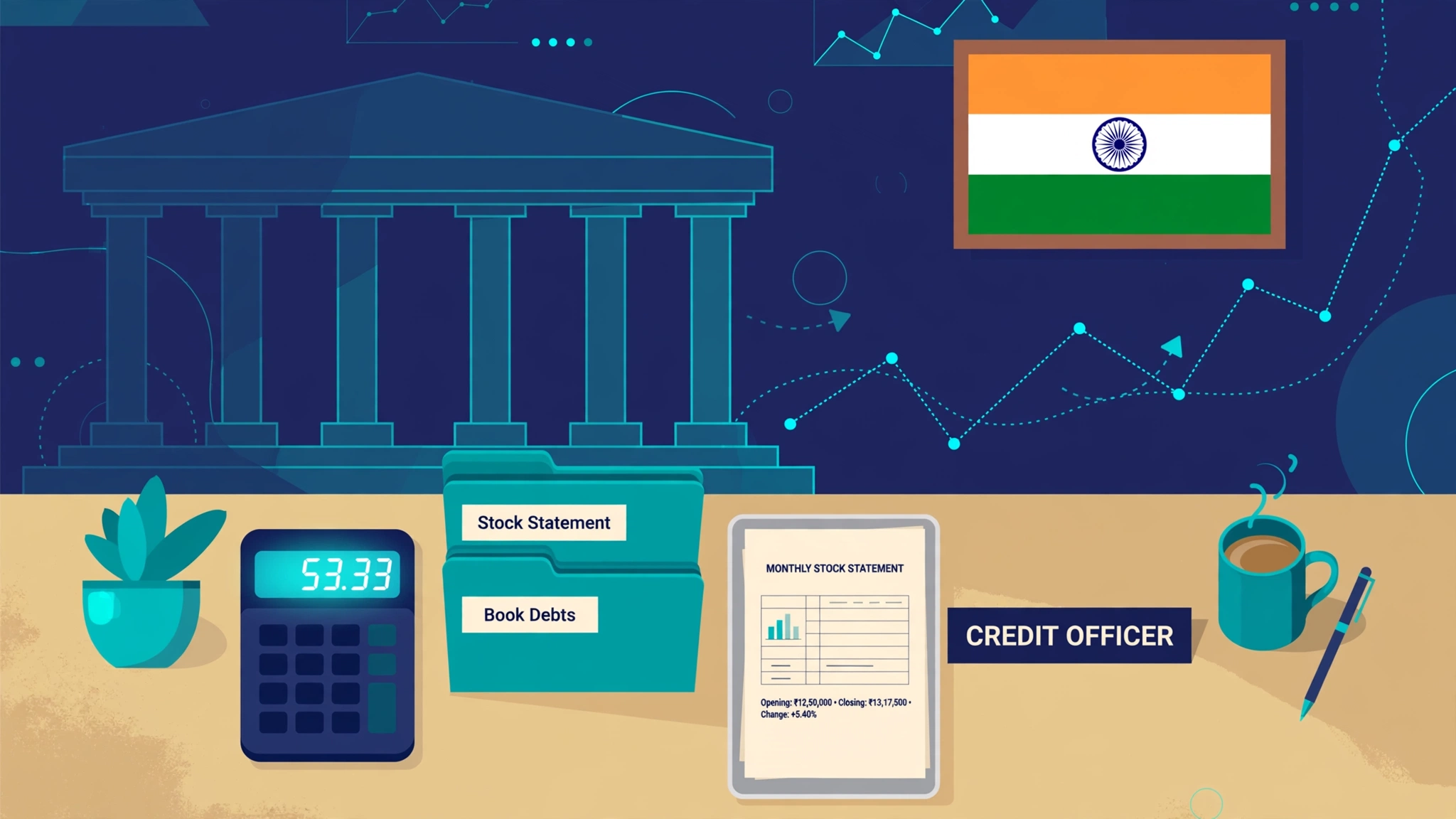
- The question borrowers really ask: how much stock must I show for a ₹40 lakh limit? Answer: ₹40 lakh ÷ (1 − 25% margin) = ₹53.33 lakh of paid stock.
- The formula: (paid stock × (1 − stock margin)) + (eligible book debts × (1 − receivables margin)), capped at your sanctioned limit.
- The 25% stock and 40% receivables margins are bank convention, not an RBI rule. Your sanction letter decides the real numbers.
- Miss your statement deadline and the RBI’s 3-month rule applies: DP from a statement older than 3 months makes drawings irregular, and 90 continuous days of irregular drawings makes the account an NPA.
On a CA forum, a borrower asked a simple question: he had a ₹40 lakh overdraft from SBI and filed a monthly stock statement. How much minimum closing stock should he show? The thread ran for years. Nobody gave him the one-line answer, because every article on the internet explains the formula forward and borrowers need it backwards.
Here is the backwards answer first: with a 25% margin on stock, ₹40 lakh of drawing power needs ₹40 ÷ 0.75 = ₹53.33 lakh of paid stock. Paid stock means stock you have actually paid for, which is closing stock minus creditors. If you owe suppliers ₹10 lakh on ₹60 lakh of closing stock, your paid stock is ₹50 lakh, and that is short of the ₹53.33 lakh you need.
The rest of this guide works through the full computation the way a credit officer does it, with a worked example, the RBI rules that sit behind it, and a free calculator plus Excel sheet. Everything is in ₹ lakh.
What Is Drawing Power in Banking?
Drawing power, usually shortened to DP, is the maximum amount your bank lets you withdraw from a cash credit or overdraft account at a given time. It is recomputed every month from your latest stock statement and book-debt statement, after the bank applies its margins.
Think of it as two numbers that live on your account. The sanctioned limit is the ceiling, fixed once a year when the bank sanctions or renews your facility. Drawing power is the live number, and it moves with your business. Good month, high stock, healthy receivables: your DP sits at the ceiling. Slow month, ageing debtors, a late statement: your DP drops below it, and the account only lets you draw up to the DP.
This is also where drawing power connects to the rest of your borrowing. The sanctioned limit itself is usually justified once a year by the MPBF computation, and the DP discipline feeds into the bank’s credit appraisal at renewal. DP is the monthly heartbeat; MPBF and the CAM are the annual health check.
How Much Stock Must I Show for My Loan Limit?
This is the reverse calculation, and it is the one borrowers actually use. Rearrange the formula: required paid stock = desired drawing power ÷ (1 − margin on stock). The calculator below does both directions. Try your own numbers.
Drawing Power Calculator
Paid stock: ₹56.00 lakh × (1 − 25%) = ₹42.00 lakh DP on stock
Book debts: ₹45.00 lakh × (1 − 40%) = ₹27.00 lakh DP on book debts
Gross drawing power: ₹69.00 lakh. Effective drawing power (capped at sanctioned limit): ₹60.00 lakh
Your margin contribution (money you fund yourself): ₹32.00 lakh
Margins shown are the common convention (25% stock, 40% book debts). Your sanction letter decides the real numbers. Figures in ₹ lakh.
Two things to note before you file. First, the answer is paid stock, not closing stock. Banks deduct what you owe suppliers, because financing unpaid stock would mean financing the same goods twice. The RBI’s own guidance backs this: unpaid stocks are not financed. Second, the margin in your sanction letter wins. If your letter says 30% on stock, the ₹40 lakh limit needs ₹40 ÷ 0.70 = ₹57.14 lakh of paid stock, not ₹53.33 lakh.
How Do Banks Calculate Drawing Power on Stock?
The officer starts with your monthly stock statement and applies three steps: take closing stock, deduct unpaid stock, apply the margin. Here is a worked example for a fictional company, Gupta Electronics, a Delhi consumer-electronics distributor with a ₹60 lakh cash credit limit.
| Line | Computation | ₹ lakh |
|---|---|---|
| A. Closing stock (as per statement) | Raw material + WIP + finished goods | 68.00 |
| B. Less: unpaid stock (creditors for stock) | Stock not yet paid for | 12.00 |
| C. Paid stock | A − B | 56.00 |
| D. Less: margin at 25% | Your contribution, 0.25 × C | 14.00 |
| E. Drawing power on stock | C − D | 42.00 |
The margin is the bank’s safety buffer and your contribution. On ₹56 lakh of paid stock at 25% margin, you fund ₹14 lakh yourself and the bank funds ₹42 lakh. If the stock had to be sold in distress, the buffer absorbs the price fall. That is the entire logic of the margin in one sentence.
Where does 25% come from? It is convention, repeated across practitioner guides and bank working-capital training material. It is not an RBI prescription for general working capital. One RBI-prescribed margin does exist, but only for a specific category: advances to builders and contractors carry a minimum margin of 40 to 50%, per the RBI’s Master Circular on Management of Advances. Do not quote that number for a trading or manufacturing account. For your account, the binding document is the sanction letter.
How Do Banks Calculate Drawing Power on Book Debts?
Book debts, your receivables, get the same treatment with a higher margin and one extra filter: the cover period. Banks only count receivables that are not too old. The standard cover period is 90 days, though the exact number is set by bank policy.
Gupta Electronics shows ₹52 lakh of total receivables, but ₹7 lakh is over 90 days old. The eligible figure is ₹45 lakh. At the conventional 40% margin, DP on book debts = 45 × 0.60 = ₹27 lakh. The borrower’s own contribution here is ₹18 lakh.
Two discipline points. First, ageing matters every month: a debtor that was 80 days old last month and is 95 days old this month silently drops out of your DP. Second, most banks ask for the book-debt statement certified by your CA on a quarterly or half-yearly basis, so the numbers have to tie to your books. A stock statement that disagrees with the trial balance is the fastest way to trigger a stock audit.
Can Drawing Power Be More Than the Sanctioned Limit?
The computed figure can be higher, but you can never draw more than the sanctioned limit. Effective drawing power = lower of (DP on stock + DP on book debts) and the sanctioned limit. For Gupta Electronics: ₹42 lakh + ₹27 lakh = ₹69 lakh of computed DP, capped at the ₹60 lakh sanctioned limit. Effective DP: ₹60 lakh.
This confuses borrowers every month. One borrower posted his overdraft-against-book-debts statement on a CA forum: drawing power ₹17.4 crore, limit ₹7.5 crore, balance outstanding ₹4.1 crore. His DP was computed purely on receivables and ran far above the limit. The answer he got is the rule: the drawable amount stays at the limit. The extra computed DP is not usable, and it does not raise the limit either. Only a renewal does that. The renewal playbook for working capital limits walks through what that renewal decides and what to prepare before the letter arrives.
The reverse also happens. If computed DP is ₹52 lakh against a ₹60 lakh limit, you can draw only ₹52 lakh, even though the sanction letter says sixty. The limit is a ceiling, never a floor.
Why Did My Drawing Power Reduce This Month?
Nobody on the internet answers this directly, so here is the checklist credit officers actually run through, in rough order of frequency:
- Your stock fell. Seasonal dip, a big dispatch at month end, or a purchase that has not arrived yet. DP tracks the statement, not your average.
- Debtors aged past the cover period. Invoices crossing 90 days drop out of eligible receivables silently. This is the most common surprise.
- Your statement arrived late. The bank kept computing DP on an older statement, or used its discretion to cut it. Kotak’s published fee schedule charges ₹5,000 per month for delayed stock or book-debt statements and lets the bank drop the DP entirely if the statement is more than 15 days past due.
- The stock audit found a lower value. The panel auditor’s valuation replaces your book figure for DP. Banks order these audits periodically; the RBI’s Management of Advances circular recommends a system of periodical stock audit for working capital finance.
- Stock got excluded. Obsolete or non-moving stock, consignment stock, job-work stock, and stock already hypothecated to another bank do not count. See the next section.
- The limit itself was renewed lower. Then the cap moved, not the computation.
Ask your branch for the DP working. It is a one-page sheet with each of these lines, and it shows exactly which line moved. Officers share it routinely.
What Does the Bank Exclude From Your Stock Statement?
Not everything in your godown counts. Bank DP guidelines typically exclude:
- Obsolete, damaged, or non-moving stock
- Stock held on consignment or on job-work basis (it is not yours)
- Stock already hypothecated to another bank, or under packing credit
- Unpaid stock, to the extent of the creditors (financing it would be double financing)
On the plus side, advances you have paid toward raw-material purchases usually count, since that money is locked in your working capital. The exact exclusion list sits in your bank’s DP guidelines and your sanction letter. Read those two pages before you argue about a cut.
What Are the RBI Rules on Drawing Power?
Two RBI rules matter, and both are about the statement being current. First, the IRAC master circular on asset classification, para 4.2.4: drawing power must be arrived at based on a current stock statement. Stock statements relied upon for DP should not be older than three months. DP worked out from older statements makes the drawings irregular. And a working capital account becomes an NPA if such irregular drawings continue for a continuous period of 90 days, even if the unit is working fine.
Read that again, because borrowers miss the bite: the account can turn NPA purely on paperwork ageing, with no default on interest or instalments. This is also one of the early warning signals a bank’s risk team watches. Keeping the statement current is not admin. It is asset classification.
Second, the RBI’s Master Circular on Management of Advances (April 8, 2022) recommends that lenders keep a system of periodical stock audit in working capital finance, as a monitoring and end-use measure. In practice, banks run these audits annually for working capital limits of ₹1 crore and above. The auditor’s number can replace yours in the DP working, so the audit is the moment of truth for every stock statement you filed that year.
How Do I Keep My Drawing Power Intact?
Four habits, none of them clever:
- File on time, every month. Know your bank’s due date (often within 10 days of month close) and treat it like an EMI date. The 3-month RBI clock and the 15-day bank discretion both start from lateness.
- Reconcile the statement with your books first. The stock figure, the creditors figure, and the debtors ageing should all tie to the trial balance. Officers cross-check, and a mismatch invites a stock audit.
- Watch your receivables ageing like a hawk. Follow up on invoices approaching 90 days not just for cash flow, but because each one that crosses the line shrinks next month’s DP.
- Keep a copy of your sanction letter’s DP clause. Margins, cover period, exclusions, and the due date all live there. When DP drops, that clause tells you whether the bank acted within its rights.
Doing this by hand in a spreadsheet every month is exactly where errors creep in: a wrong cell reference, an ageing bucket that does not roll, a creditors figure picked from the wrong month. If you want the wider picture on why manual spreadsheet work keeps failing in credit analysis, read why manual Excel bank analysis fails. And if you are preparing the annual CMA alongside the monthly statements, our CMA data guide shows how the same stock numbers feed Statement IV.
Where Can I Download the Drawing Power Excel Calculator?
The workbook has three sheets: DP on stock, book-debt ageing, and a summary that caps the total at your sanctioned limit. Every formula is visible, input cells are marked, and built-in checks flag a statement date older than three months or a DP above the limit. It mirrors the Gupta Electronics example so you can see the mechanics before typing your numbers.
Drawing Power Excel Calculator
Stock DP sheet · Book-debt ageing sheet · Sanctioned-limit cap · 3-month statement check · No sign-up needed
Filing stock statements every month? CrediLens reads financial documents the way a credit officer does, so your statements, ageing, and DP computation come out clean the first time. See how it works
Sources
- RBI Master Circular on IRAC norms, para 4.2.4: DP must be based on a current stock statement; statements older than three months make drawings irregular; 90 continuous days of irregular drawings makes a working capital account an NPA.
- RBI Master Circular on Management of Advances (DOR.CRE.REC.No.17/13.05.000/2022-23, April 8, 2022): recommends a system of periodical stock audit in working capital finance for monitoring and end-use of funds.
- Kotak Mahindra Bank fee schedule for cash credit / overdraft: ₹5,000 per month for delayed stock or book-debt statements; the bank may drop the drawing power if the statement is not received within 15 days of the due date.
- HPSCB policy for stock audit of bank borrowers: annual stock audit by panel chartered accountants for working capital limits of ₹1 crore and above.
Margin figures (25% on stock, 40% on book debts) and the 90-day receivables cover period are industry convention and vary by bank; the binding source is the individual sanction letter, as noted through the article. The forum questions cited come from public CAclubindia and TaxTMI threads.
Frequently Asked Questions
How much stock should I show for a ₹40 lakh OD limit?
Work backwards from the margin. With a 25% margin on stock, the paid stock you need is ₹40 lakh ÷ (1 − 0.25) = ₹53.33 lakh. Paid stock means closing stock minus creditors. If some stock is unpaid, show more closing stock so the paid portion still reaches ₹53.33 lakh. Confirm the margin in your sanction letter first.
What is the difference between drawing power and sanctioned limit?
The sanctioned limit is the ceiling fixed once a year at sanction or renewal. Drawing power is recomputed every month from your latest stock and book-debt statements, and it is the lower of the computed figure and the sanctioned limit. The limit is the roof; drawing power is how much of the room you can actually use this month.
Can drawing power be more than the sanctioned limit?
The computed figure can be higher, for example when book debts are strong, but you can never draw more than the sanctioned limit. The effective drawing power is always the minimum of the two. One borrower’s overdraft-against-book-debts account showed a computed DP of ₹17.4 crore against a limit of ₹7.5 crore; the drawable amount stayed ₹7.5 crore.
What is the drawing power formula banks use?
DP on stock = (closing stock − unpaid stock) × (1 − stock margin). DP on book debts = eligible receivables within the cover period × (1 − receivables margin). Effective DP = lower of the two DPs added together and the sanctioned limit. The convention is 25% on stock and 40% on receivables, but your sanction letter is binding.
Why did my drawing power reduce this month?
The usual causes: your stock fell, some debtors aged past the 90-day cover period and were dropped, your statement arrived late so the bank used older figures, the stock audit found a lower value than your books, or obsolete stock was excluded. Ask your branch for the DP working; it shows line by line which one moved.
What happens if I do not submit my stock statement on time?
The bank first computes DP on your last available statement, then stops. Under RBI IRAC norms, DP from a statement older than three months makes drawings “irregular”, and 90 continuous days of irregular drawings makes the account an NPA. Banks also penalise delays: Kotak’s published schedule charges ₹5,000 per month and lets the bank drop the DP if the statement is over 15 days late.
Where can I download a drawing power calculator in Excel?
From the download section above: a free Excel workbook with a stock DP sheet, a book-debt ageing sheet, and a summary that caps the total at your sanctioned limit. All formulas are visible, input cells are marked, and built-in checks flag a stale statement date or a DP above the limit. No sign-up needed.
Last updated: October 2026. Regulatory claims in this article were checked against primary RBI sources; see the Sources section above. Margin and cover-period figures are stated as convention with the sanction letter as the binding source. The worked example uses a fictional company.
Get Free CAM Sample Report & AI Parser Demo
Request the official banking CAM Excel template and see how BaseWorks automates bank statement parsing & ratio calculation in seconds.