CAM stands for Credit Appraisal Memorandum. It is one of the most critical documents in the loan approval process, the bank's internal evaluation note on which every sanction decision rests. This guide to CAM in banking covers its full form and meaning, key components, the step-by-step preparation process, the financial ratios officers compute, the types of CAM reports, the RBI regulatory framework, and how technology is changing CAM preparation.

TL;DR: CAM in 30 seconds
- Full form: Credit Appraisal Memorandum (also used in finance more broadly with the same meaning).
- What it is: the bank's internal, officially documented appraisal of a loan proposal.
- Who writes it: relationship managers, credit officers, or dedicated credit appraisal teams.
- What it contains: borrower profile, loan proposal details, financial analysis, risk assessment, and a sanction recommendation.
- Who sees it: the bank's credit committee or sanctioning authority; the borrower never writes it and usually never sees it.
What is CAM in Banking?
CAM, or Credit Appraisal Memorandum, is a comprehensive document prepared by banks and financial institutions to assess the creditworthiness of a loan applicant. It's the starting point of the organized appraisal of a loan proposal and serves as the foundation for all lending decisions.
The one-line definition
A CAM is the starting point of an organised, officially documented appraisal of a loan proposal. Every sanction decision rests on this note.
Primary Purpose
Systematic evaluation of borrower's creditworthiness and loan viability before sanction.
Who Prepares It
Relationship Managers, Credit Officers, or dedicated Credit Appraisal Teams.
Key Components of a CAM Report
Borrower Information
- Personal Details: Name, address, contact information
- Financial Background: Occupation, income sources, assets
- Credit History: CIBIL score, existing loans, repayment track record
- Business Profile: (For business loans) Industry, turnover, market position
Loan Proposal Details
- Loan Amount: Requested principal amount
- Purpose: End-use of funds (business expansion, personal needs, etc.)
- Tenure: Repayment period and schedule
- Security: Collateral details and valuation
Financial Analysis
- Income Assessment: Salary slips, bank statements, tax returns
- Expense Analysis: Monthly outflows and financial obligations
- Repayment Capacity: Debt-to-Income ratio, EMI calculations
- Cash Flow Projection: Future income and expense forecasting
Risk Assessment
- Credit Risk: Probability of default and loss severity
- Market Risk: Industry trends and economic conditions
- Operational Risk: Business continuity and management quality
- Mitigation Measures: Security coverage and personal guarantees
When this assessment surfaces early warning signals, the lender can red-flag the account and the file moves into a different process. See what a red-flagged account (RFA) means under RBI rules.
Recommendations
- Approval/Decline: Clear recommendation with justification
- Conditions: Prerequisites for loan sanction
- Terms & Conditions: Interest rate, processing fees, covenants
- Monitoring Requirements: Post-sanction review triggers
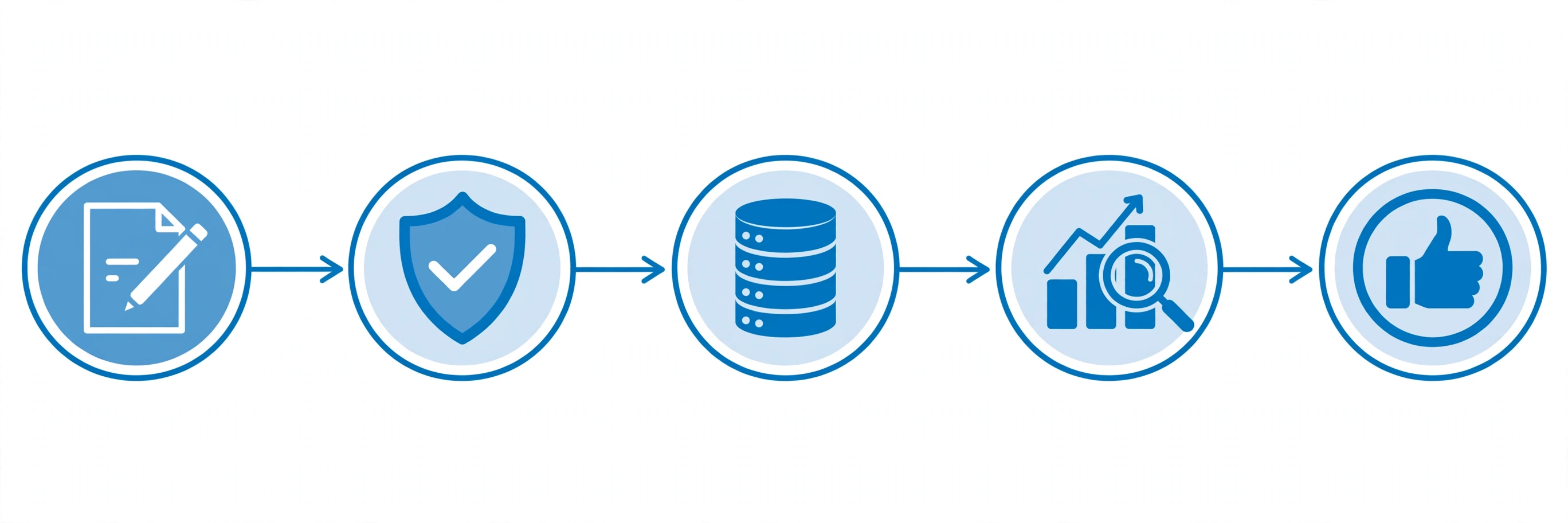
CAM Preparation Process: Step-by-Step Guide
Application
Receive and review loan application
KYC Verification
Verify identity and address
Data Collection
Gather financial documents
Analysis
Financial and risk analysis
Recommendation
Prepare CAM and submit for approval
Critical Success Factors
This five-step CAM routine is one chapter of a wider twelve-stage appraisal. For the full picture, from enquiry and KYC through bureau checks, sanction, and disbursement, see the credit appraisal process in banks, step by step.
Key Financial Ratios Used in CAM Analysis
| Ratio | Formula | Ideal Range | Interpretation |
|---|---|---|---|
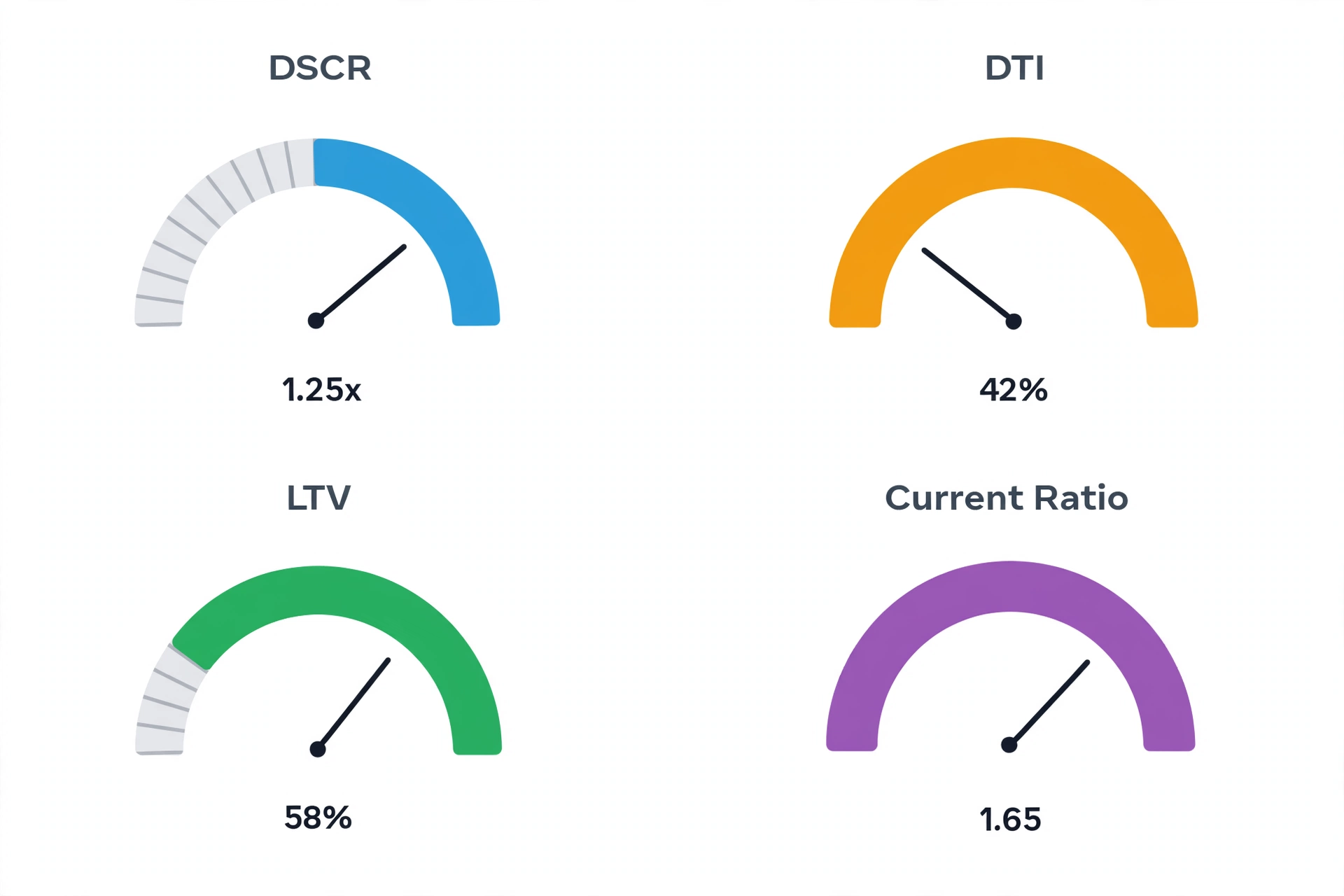
| Debt-to-Income (DTI) | (EMI + Existing Debt) / Gross Income | < 50% | Lower ratio indicates better repayment capacity |
| Loan-to-Value (LTV) | Loan Amount / Property Value | < 80% | Lower LTV means more security for lender |
| Debt Service Coverage Ratio (DSCR) | Net Operating Income / Debt Service | 1.25x and above (1.5x+ preferred) | Most Indian PSU banks look for at least 1.25x for trading/service businesses and around 1.5x for manufacturing; below 1.0x signals repayment stress. See our DSCR guide for the bank formula, the real story of 1.33, and reverse loan sizing. |
| Current Ratio | Current Assets / Current Liabilities | 1.5:1 to 2:1 | 1.33:1 is the classic Indian working-capital benchmark (Tandon Committee); 1.5:1 to 2:1 is the healthy range most banks look for |
Types of CAM Reports
Retail CAM
- • Personal loans
- • Home loans
- • Education loans
- • Focus on individual creditworthiness
Corporate CAM
- • Business loans
- • Working capital
- • Project finance
- • Emphasis on business financials
MSME CAM
- • SME loans
- • MSME finance
- • Trade finance
- • Simplified assessment framework
The CAM also changes with the facility it is written for: a term loan CAM and a working capital CAM ask different questions, use different ratios, and put different weight on the borrower's cash flows. See how the CAM differs for term loans vs working capital, with the same borrower file worked through both versions.
Common Challenges in CAM Preparation
Data Incompleteness
Borrowers often provide incomplete documentation, requiring multiple follow-ups and delaying the appraisal process.
Data Verification Burden
Manual verification of bank statements, salary slips, and credit reports is time-consuming and prone to human error. See why manual Excel bank analysis keeps failing and the bank statement analysis challenges Indian lenders face every day. For what an officer actually reads first in those statements, see bank statement analysis: what credit officers look for.
Tired of verifying statements by hand?
See how CrediLens parses bank statements in minutes, or grab our free CAM template.
Request Free CAM TemplateRegulatory Compliance Pressure
Constantly evolving RBI guidelines and compliance requirements add complexity to the CAM preparation process.

Role of Technology in Modern CAM Preparation
Modern CAM preparation is increasingly leveraging technology to overcome traditional challenges and improve efficiency. Our comprehensive bank statement analysis guide walks through what automated parsing actually looks like in practice.
Traditional Approach
- Manual Data Entry:
Copy-paste from PDFs to Excel sheets
- Manual Calculations:
Formula-based ratio calculations
- Static Reports:
Fixed format templates and layouts
AI-Powered CAM
- Automated Extraction:
OCR and AI extract data from statements
- Smart Risk Scoring:
Automated risk assessment and scoring
- Dynamic Reports:
Interactive dashboards and real-time insights
Regulatory Framework Governing CAM
One clarification that matters: the RBI does not prescribe a single CAM format. Each bank's board-approved credit policy defines its own CAM template and appraisal workflow. The RBI requires banks to have documented loan policies, but the note itself is a bank-internal document.
That said, several RBI frameworks shape what goes into every CAM: the IRAC norms (Income Recognition, Asset Classification and Provisioning), which decide how the bank classifies the asset it is about to create; KYC / Customer Due Diligence and PMLA requirements, which feed the borrower-information section; and the RBI Master Directions on Fraud Risk Management (July 2024), whose early-warning-signal and red-flagging framework informs the risk-assessment section. Read our early warning systems guide. If you want the IRAC side in plain borrower language, see our RBI IRAC norms decoded for borrowers: it explains how SMA tags and the 90-day NPA rule decide what happens to your limit after sanction.
Key Regulatory References
- IRAC norms: RBI Master Circular on Income Recognition, Asset Classification and Provisioning
- KYC / CDD and PMLA: Customer Due Diligence and Prevention of Money Laundering Act, 2002
- Fraud Risk Management: RBI Master Directions (July 2024), early warning signals and red flagging of accounts
Sources available at rbi.org.in.
CAM Approval Process and Hierarchical Levels
Indicative: thresholds and authorities vary across banks; this is a representative example.
| Approval Level | Loan Amount Range | Approving Authority | Review Process |
|---|---|---|---|
| Level 1 | ₹0 - ₹10 Lakhs | Branch Manager | Single approval based on preset parameters |
| Level 2 | ₹10L - ₹50 Lakhs | Regional Manager | Credit committee review required |
| Level 3 | ₹50L - ₹2 Crores | Zonal Head | Board-level approval with detailed scrutiny |
| Level 4 | Above ₹2 Crores | Board of Directors | Extensive due diligence and legal review |
Best Practices for CAM Preparation
Documentation Standards
- Standardized templates and formats
- Complete documentation checklist
- Version control and audit trails
- Digital signatures and timestamps
Quality Control Measures
- Peer review and validation process
- Independent risk assessment
- Compliance checklist verification
- Management oversight and approval
What Does "CAM Writing Experience" Mean in Banking Jobs?
If you have seen "CAM writing experience" in a credit-officer or relationship-manager job description, it means hands-on experience drafting Credit Appraisal Memorandums, not just reading them. Specifically, banks mean you can:
- Gather and organise borrower financials: bank statements, ITRs, salary slips, and CMA data from the borrower or their CA.
- Compute the appraisal ratios: DSCR, current ratio, DTI, LTV, and interpret what they say about repayment capacity.
- Write the risk assessment: borrower profile, industry outlook, credit history, and risk mitigants, in the bank's own CAM format.
- Draft the recommendation: approve or decline with conditions, in language a credit committee can act on.
How to get it: most credit officers build CAM writing experience as credit analysts or assistant RMs, drafting CAMs under a senior officer's review. If you are preparing for interviews, expect to be asked to walk through a sample CAM section-by-section and defend a mock recommendation.
Future of CAM in Banking
The credit appraisal memorandum is evolving with technological advancements and changing regulatory landscapes.
AI-Driven Appraisals
Automated bank-statement parsing, ratio computation, and risk scoring, cutting the manual data-entry burden that delays most CAMs today.
Real-Time Analysis
Continuous monitoring of borrower accounts, in the same direction as the RBI's 2024 fraud-risk directions, which pushed banks toward early-warning frameworks integrated with core banking systems.
Living Documents
The annual CAM review cycle is becoming continuous, with triggers from account behaviour rather than calendar dates.
"A well-prepared CAM is not just a compliance requirement, it's the foundation of sound lending decisions that protect both the lender and the borrower in the long term."
Frequently Asked Questions
What is the full form of CAM in banking?
CAM stands for Credit Appraisal Memorandum. It is the bank's internal evaluation report on a loan proposal, covering the borrower's profile, financial analysis, risk assessment, and a sanction recommendation, prepared before any loan is approved.
What does CAM mean in banking?
In banking, CAM means the Credit Appraisal Memorandum: the official appraisal note a credit officer prepares for the sanctioning authority. For retail loans (personal, home), officers often prepare a salary CAM analysing 6 to 12 months of bank statements, Form 16, and salary slips to compute the Debt-to-Income ratio and repayment capacity.
What is the full form of CAM in finance?
In finance, CAM also stands for Credit Appraisal Memorandum, the documented credit evaluation behind a lending decision. Outside lending, CAM can mean other things, such as Computer-Aided Manufacturing. You may also see the variant "Credit Analysis Memorandum" on some websites; in Indian banking, "Credit Appraisal Memorandum" is the standard.
What is the difference between CAM and CMA?
CAM (Credit Appraisal Memorandum) is the bank's internal appraisal note; CMA (Credit Monitoring Arrangement) is the borrower's structured financial data, balance sheet, P&L, cash flow and MPBF computation, submitted to the bank, usually via their CA. The CMA feeds into the CAM.
What is CAM in ICICI Bank and HDFC Bank?
In ICICI Bank, HDFC Bank, SBI, and other major lenders, CAM stands for Credit Appraisal Memorandum, the formal underwriting note submitted to the credit committee, containing cash-flow projections, DSCR, collateral valuation, and risk rating scores.
Where can I get a CAM report template or sample format?
Request a standard CAM report Excel/PDF sample format via our lead form below; we share banking credit-appraisal templates along with automated statement-parsing previews.
Get Free CAM Sample Report & AI Parser Demo
Request the official banking CAM Excel template and see how BaseWorks automates bank statement parsing & ratio calculation in seconds.