TL;DR
- DSCR = cash available for debt service divided by debt service. Above 1 means the cash covers the loan.
- Banks compute it year by year on your projected P&L, and they judge the weakest year, not just the average.
- No RBI circular fixes a DSCR floor for fresh term loans. The famous 1.33 is a 2013 restructuring benchmark recycled as appraisal folklore.
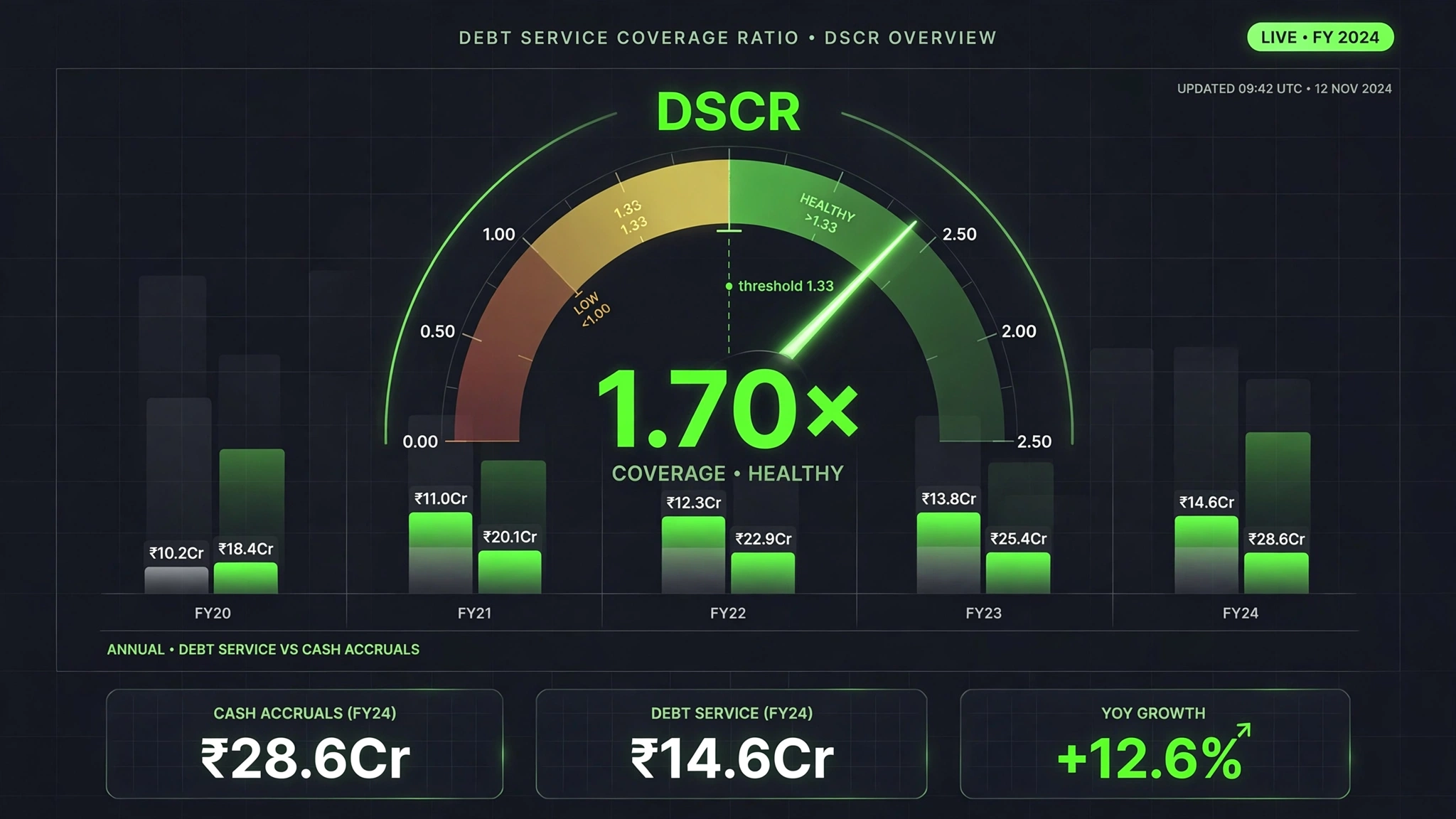
- Worked example: a ₹60 lakh, 5-year loan at 11% scores 1.70 to 1.82 across the tenure, average 1.76.
- Reverse DSCR sizes the loan from your cash flows: cash accruals ÷ threshold = max annual service, then an annuity turns it into a loan amount.
You walk into a bank and ask for ₹60 lakh for your unit. The credit officer opens a worksheet, punches in your projected P&L, and out comes a single number: your DSCR. That number decides whether the file moves forward or dies quietly. This guide explains what it measures, the exact formula Indian banks use, how to compute it year by year, where the famous 1.33 really comes from, and how to run the ratio backwards to size your own loan before you apply. Everything is in ₹ lakh, and the worked example uses a fictional company.
What Is the Debt Service Coverage Ratio?
The debt service coverage ratio measures whether a business generates enough cash in a year to pay its loan obligations that year. Obligations means the full bill: interest plus the principal instalment. A DSCR of 1.5 means the business generates ₹1.50 of cash for every rupee of debt service it owes.
DSCR = (PAT + Depreciation + Interest on term loan) ÷ (Term loan instalment + Interest on term loan)
The numerator is your cash accruals. Profit after tax, plus depreciation and other non-cash charges added back, plus interest on the term loan added back. Interest is added back because it is part of what you are measuring against: you want the cash available before servicing debt, then you compare it with the debt service. The denominator is the year’s debt service: the principal instalment plus the interest on the term loan.
Two quick reads on the number. DSCR above 1 means the cash covers the obligation, with room to spare. DSCR below 1 means the business cannot pay the loan from its own cash that year, so it must dip into reserves, borrow more, or default. That is the entire logic of the ratio in one paragraph.
What Formula Do Indian Banks Actually Use for DSCR?
Indian banks mostly use the P&L-based variant above, but at least three other versions float around. Variants can shift the answer by 0.15x to 0.30x, so the formula matters as much as the number. Always ask your bank which worksheet it uses.
| Variant | Numerator | Denominator | Where you meet it |
|---|---|---|---|
| Bank / CMA variant | PAT + depreciation + non-cash charges + interest on term loan | Term loan instalment + interest on term loan | Credit appraisal, CMA ratio block |
| EBITDA variant | EBITDA | Total debt service (all loans) | Quick screens, rating discussions |
| NOI variant (real estate) | Net operating income (rent minus operating costs) | Debt service on the property loan | Project finance, commercial real estate appraisals |
| Cash-flow variant | Operating cash flow | Total debt service | Sophisticated lenders, forensic reviews |
The bank variant is the one this article uses throughout. It is the shape you find in Bank of Baroda’s internal credit-risk model document (BOBRAM): (PAT + depreciation + interest) divided by (interest + current portion of long-term debt), with cash flows from operations used rather than profits and non-operating or extraordinary items excluded. IIBF training material uses the same shape and calls an average DSCR of 1.50 “reasonable”. That is training material and one bank’s model, not an industry standard, so treat the shape as the convention and the number as each bank’s own call.
Worked Example: How a Bank Computes DSCR on a ₹60 Lakh Term Loan
Here is a full five-year DSCR computation for a fictional borrower, built the way a credit officer builds it: from the projected P&L and the repayment schedule, year by year.
Setup: Mehta Packaging Pvt Ltd, Indore. ₹60 lakh term loan, 11% p.a., 5 years. The annual instalment is ₹16.23 lakh (the EMI formula: loan × rate ÷ (1 − (1 + rate)−tenure)). PAT starts at ₹15 lakh and grows 10% a year. Depreciation is ₹6 lakh a year.
| Figure (₹ lakh) | Year 1 | Year 2 | Year 3 | Year 4 | Year 5 |
|---|---|---|---|---|---|
| Interest on term loan | 6.60 | 5.54 | 4.36 | 3.06 | 1.61 |
| Principal instalment | 9.63 | 10.69 | 11.87 | 13.18 | 14.62 |
| PAT | 15.00 | 16.50 | 18.15 | 19.97 | 21.96 |
| Depreciation | 6.00 | 6.00 | 6.00 | 6.00 | 6.00 |
| Numerator (PAT + dep + interest) | 27.60 | 28.04 | 28.51 | 29.02 | 29.57 |
| Denominator (annual debt service) | 16.23 | 16.23 | 16.23 | 16.23 | 16.23 |
| DSCR | 1.70 | 1.73 | 1.76 | 1.79 | 1.82 |
Average DSCR is 1.76; the minimum, in year 1, is 1.70. The file clears the usual comfort zone. Notice what the bank looks at: both the average and the weakest year. A file with a healthy average but one year at 0.9 still has a problem, because that is the year the borrower cannot pay. This exact table is in the free workbook below: change the yellow cells and it recalculates everything.
What DSCR Do Banks Look for, and Is 1.33 Really an RBI Rule?
No RBI circular fixes a DSCR floor for a fresh term loan. But the number 1.33 did come from RBI, just from a different job. Here is the actual story.
On May 30, 2013, RBI issued a circular reviewing prudential guidelines on restructuring of advances (DBOD.BP.BC.No.99/21.04.132/2012-13). Its appendix, “Broad benchmarks for the viability parameters”, said this, verbatim: “The debt service coverage ratio should be greater than 1.25 within the 5 years period in which the unit should become viable and on year to year basis the ratio should be above 1. The normal debt service coverage ratio for 10 years repayment period should be around 1.33.”
That was a viability test for restructured, stressed accounts: is this sick unit worth saving? It was never a sanction norm for fresh loans. Note the wording too: “should be greater than”, “should be above”, “should be around”. Not “shall”, not mandatory. Over the years, bankers carried the number from stressed-account work into everyday appraisal, and 1.33 became folklore.
Meanwhile, RBI’s own language for fresh lending is deliberately soft. The Master Circular on IRAC norms, para 4.2.15, says only that the revised DSCR “should be acceptable to the lenders”: a discretion test, no number. And the February 2014 circular on the Joint Lenders’ Forum lists DSCR as one of the “illustrative” viability parameters, with benchmarks “determined by” the lenders themselves. In short: RBI recognises the ratio and leaves the number to the bank.
So what do banks actually use? In practice, 1.25 as a floor and 1.33 to 1.50 as comfort, with project finance stretching to 1.50 and above. IIBF training material calls an average DSCR of 1.50 “reasonable”. But every bank’s credit policy sets its own number, and sectors differ. The binding document is your sanction letter. Ask for the threshold in writing before you apply, and you will never argue about folklore again.
How Can You Size a Loan With Reverse DSCR?
Most borrowers use DSCR forward: given a loan, do I clear the threshold? The more useful direction is backwards: given my cash flows and the bank’s threshold, what is the maximum loan I can carry? RBI itself thinks this way. The same 2013 appendix defines the Loan Life Ratio as the present value of cash flows divided by the maximum loan amount, with a benchmark of 1.4: a 40% cushion on the loan, computed from cash. Reverse DSCR is the same instinct, applied to your own numbers.
Step 1: find the maximum annual debt service. Divide your projected annual cash accruals by the threshold. Cash accruals of ₹24 lakh a year and a 1.33 threshold give ₹24 ÷ 1.33 = ₹18.05 lakh a year of serviceable debt.
Step 2: convert the annual service into a loan amount. An annual payment supports a loan equal to the payment times the annuity factor: (1 − (1 + rate)−tenure) ÷ rate. At 11% over 5 years the factor is 3.6959, so ₹18.05 lakh a year supports ₹18.05 × 3.6959 = ₹66.69 lakh.
| Threshold | Max annual service (₹ lakh) | Supportable loan (₹ lakh) |
|---|---|---|
| 1.25 | 19.20 | 70.96 |
| 1.33 | 18.05 | 66.69 |
| 1.50 | 16.00 | 59.13 |
The sensitivity is the point. The same ₹24 lakh of cash accruals supports ₹70.96 lakh at a 1.25 threshold and only ₹59.13 lakh at 1.50: the threshold moves the answer by nearly ₹12 lakh. And the math closes its own loop: take the ₹66.69 lakh loan at 11% over 5 years, and its annual service is ₹18.05 lakh, so DSCR = 24 ÷ 18.05 = 1.33, exactly the threshold. The Reverse Sizing tab of the workbook does all of this with visible formulas, so you can check every step.
Where Does DSCR Sit in a CMA Report?
DSCR sits in the Ratio Analysis block of the CMA, and it is computed on your projected years, not just on history. The IBA-format CMA has seven statements; the sixth is the ratio block, carrying the current ratio, DSCR, and TOL/TNW. Your projected P&L builds the numerator (projected PAT, projected depreciation), and the proposed repayment schedule builds the denominator. That is why a weak projection breaks two things at once: the projected profits look thin and the DSCR collapses. Our CMA data guide walks through the full format, and the MPBF guide covers the working-capital half of the same appraisal.
DSCR vs ICR vs FOIR: Which Ratio Answers Which Question?
Three ratios, three different questions. Confusing them is how borrowers walk in confident and walk out rejected.
| Ratio | Numerator | Denominator | Answers |
|---|---|---|---|
| DSCR | Cash accruals + interest | Principal + interest | Can the business service the whole loan? |
| ICR (interest coverage) | EBIT | Interest only | Can it cover interest in a bad year? |
| FOIR (fixed obligation to income) | Monthly income | EMIs + fixed obligations | Can a person afford the EMIs? |
The one-line illustration practitioners use: a company can show a strong 3x ICR and only 1x DSCR, because principal is usually the larger part of the cash outflow. That is exactly why a credit officer never stops at ICR for a term loan. FOIR is the retail lens (salary versus EMIs); DSCR is the business lens (operating cash versus debt service). If you are a company applying for a term loan, DSCR is the ratio that decides your file.
What Drags DSCR Down, and How Do You Fix a Low One?
A low DSCR traces to one of four levers. Find the lever before you touch the numbers.
- Profits too thin. The numerator starts with PAT. If margins are weak, no repayment structure fixes the ratio. Improve the operating story first.
- Interest too high. A cheaper rate or a longer tenure cuts the denominator directly. Run the reverse-DSCR math at two rates before negotiating.
- Principal too bunched. Heavy early instalments crush the first years. A longer tenure, a moratorium, or a balloon structure spreads the load.
- One-off hits in the year. A genuine non-recurring expense can be legitimately adjusted, but the bank will want proof, and your bank statements must agree with the story.
One thing you must not do: inflate the projections to manufacture the ratio. Banks back-test your projections against your last three years of financials and your bank statements, and a DSCR built on fantasy projections is how files get rejected or, worse, flagged. A DSCR sliding below 1 for two running years is exactly the kind of input that feeds a bank’s early warning system. Build the ratio on numbers you can defend, then use the workbook to find the biggest loan those numbers honestly support. For the full picture of how a bank judges your file, see our CAM guide; if you also hold working capital, the drawing power and stock audit guides cover the other half of your limits.
Where Can I Download the DSCR Calculator Workbook?
The workbook has three sheets. Forward DSCR runs the five-year Mehta Packaging computation with your own numbers: yellow input cells, every result a visible formula, average and minimum DSCR, and a PASS/REVIEW verdict against your bank’s threshold. Reverse Sizing turns your cash accruals and a threshold into a maximum loan amount with the annuity math, plus a sensitivity table across 1.25, 1.33, and 1.50. The Checks sheet reconciles everything with four PASS/FAIL formulas.
DSCR Calculator Workbook
Forward DSCR sheet \u00b7 Reverse loan-sizing sheet \u00b7 4 PASS/FAIL checks \u00b7 No sign-up needed
Building DSCR by hand in a spreadsheet? One wrong cell reference and the ratio lies to you. CrediLens reads financial documents the way a credit officer does, so your CMA ratios come out clean before anyone checks them. See how it works
Sources
- RBI Master Circular on IRAC norms (RBI/2023-24/06): para 4.2.15 says the revised DSCR “should be acceptable to the lenders” (discretion test, no number).
- RBI circular DBOD.BP.BC.No.97/21.04.132/2013-14 (Feb 26, 2014): para 4.3.8 lists DSCR as an “illustrative” viability parameter, with benchmarks “determined by” the lenders.
- RBI circular DBOD.BP.BC.No.99/21.04.132/2012-13 (May 30, 2013), Appendix “Broad benchmarks for the viability parameters”: DSCR “should be greater than 1.25” in the 5-year viability window, “above 1” year on year, “around 1.33” normal for 10-year repayment; Loan Life Ratio “should be 1.4”. (Full circular text; these are restructuring-viability benchmarks, not fresh-loan sanction norms.)
- Bank of Baroda’s BOBRAM internal credit-risk model document (publicly hosted): DSCR = (PAT + depreciation + interest) ÷ (interest + current portion of long-term debt), using cash flows from operations. A bank worksheet, not a published policy page.
- IIBF Certified Credit Professional study material (thetruebanker.com): “Average DSCR of 1.50 is considered reasonable”. Training material, not bank policy.
- RBI Financial Stability Report, June 2026 (reported by The Economic Times): listed private non-financial companies’ interest coverage ratio at 6.5 in Q4FY26, with 18.5% of firms classed vulnerable (ICR below 1).
Threshold figures (1.25 floor, 1.33 to 1.50 comfort band, 1.50+ for project finance) are described as common bank practice, not RBI law; the binding source is the individual sanction letter. The worked example uses a fictional company.
Frequently Asked Questions
What is the formula for DSCR?
DSCR = (PAT + depreciation + interest on term loan) ÷ (term loan instalment + interest on term loan). The numerator is the cash your business generates; the denominator is what the loan demands that year. A result of 1.5 means ₹1.50 of cash for every rupee of debt service. Variants exist, so ask your bank which worksheet it uses.
What is the minimum DSCR banks accept in India?
There is no single RBI-mandated minimum for fresh term loans. In practice Indian banks treat 1.25 as a floor and 1.33 to 1.50 as comfort; project finance often wants 1.50 or more. Each bank’s credit policy sets its own number, and your sanction letter is the binding document. Ask for the threshold in writing before you apply.
Is 1.33 an RBI rule?
Not for fresh loans. The 1.33 figure comes from the appendix of RBI’s May 2013 restructuring circular, which said the ‘normal’ DSCR for a 10-year repayment period ‘should be around 1.33’ as a viability benchmark for stressed, restructured accounts. Banks later adopted it as a rule of thumb. It is useful folklore, but it is not a sanction norm.
How is DSCR different from the interest coverage ratio (ICR)?
ICR tests only interest: EBIT ÷ interest. DSCR tests the whole obligation: cash accruals ÷ (principal + interest). A company can show a strong ICR while barely covering the full loan, because principal is usually the larger cash outflow. That is why credit officers never stop at ICR for term loans.
What is a good DSCR for a term loan?
Above 1.33 is comfortable for most Indian banks; 1.25 to 1.50 is the usual acceptance band; project lenders often want 1.50 or higher on average across the tenure. What matters most is the minimum year, not just the average: every year must clear 1, because one weak year can break the schedule.
Is DSCR calculated for every year of the loan?
Yes. Banks compute DSCR year by year across the proposed repayment period, using your projected P&L and the repayment schedule. They look at both the average and the weakest year. A loan with a healthy average but one year at 0.9 still has a problem, because that is the year you cannot pay.
How do banks decide the loan amount from DSCR?
They run the ratio backwards. Take your projected annual cash accruals and divide by the threshold: ₹24 lakh ÷ 1.33 = ₹18.05 lakh of annual debt service you can carry. Convert that into a loan amount with the annuity formula. At 11% over 5 years, that service supports about ₹66.7 lakh. The free workbook on this page does the math.
Last updated: September 2026. Regulatory claims in this article were checked against primary RBI sources; see the Sources section above. Bank-policy thresholds are stated as common practice with the sanction letter as the binding source. The worked example uses a fictional company.
Get Free CAM Sample Report & AI Parser Demo
Request the official banking CAM Excel template and see how BaseWorks automates bank statement parsing & ratio calculation in seconds.